Sept. 21, 2026

The Gamification of Buying a Home: When Should You Stop Looking?

Buyer Strategy

The Gamification of Buying a Home: When Should You Stop Looking?

By Catherine Worthy, REALTOR® · The Worthy Group, Oakwyn Realty Ltd.

Buying a home has a strange psychological problem built into it.

You find a house you really like, but immediately wonder:

What if something better comes along next week?

So you keep looking.

Then another good house appears. You like that one too, but you've only seen five houses. Surely you shouldn't buy yet.

Twenty houses later, you're comparing every new listing to a house you saw three months ago and wishing you had bought it.

Welcome to the gamification of buying a home.

There is actually a mathematical problem that looks remarkably similar to this. It's called the Secretary Problem, and although I wouldn't recommend letting a mathematical formula decide where you're going to live, there is something useful we can learn from it.

The Secretary Problem

Imagine you need to hire someone for a job.

You interview candidates one at a time. After each interview, you have to either hire that person or let them go. Once they're gone, you can't go back and hire them later.

How many candidates should you interview before you stop gathering information and start making a decision?

Mathematicians have studied this problem extensively. Under the classic assumptions, the optimal strategy is to observe roughly the first 37% of the candidates without choosing one. You then select the next candidate who is better than everyone you've seen before.

Interesting.

But houses aren't secretaries.

And that's where things get more useful.

Your First Few Houses Have a Job

When I work with buyers, I don't think the first few houses they see are wasted opportunities if they don't buy them.

Those houses are teaching us something.

You might start by telling me:

"I absolutely need four bedrooms."

Then we walk through a beautifully renovated three-bedroom home with a large den and suddenly you realize you don't.

Or you might tell me:

"I need a huge yard."

After looking at several houses, you realize what you actually want is privacy, not necessarily acreage.

That's important information.

The early part of a home search is partly about calibration.

You're learning what your budget buys, what compromises bother you and, perhaps more importantly, which ones don't.

We Recently Put This Theory to the Test

I have clients looking for a detached home in the Highland Secondary catchment area in Comox, with a maximum budget of $800,000.

Early in their search, they found a house that became their benchmark.

It sold for $765,000 and offered four bedrooms, two bathrooms, approximately 1,750 square feet and a .32-acre lot.

It was a very good property for the money.

The question became:

If we don't buy this one, what are the chances we'll find another?

Instead of guessing, we looked at the data.

Over the previous 12 months, there were 36 detached homes at $800,000 or less in the Highland catchment area.

That's approximately three opportunities per month.

But that's not the whole story.

When we narrowed the criteria to homes with at least four bedrooms, two bathrooms and 1,750 square feet, there were seven.

Now we have useful information.

A house with those basic characteristics wasn't appearing three times a month.

Historically, something in that category was appearing roughly once every seven to eight weeks.

That's a very different way to think about a home search.

Stop Looking for "Better"

This is one of the biggest traps I see buyers fall into.

Once you've seen a really good house, every subsequent property gets compared to it.

But the question shouldn't necessarily be:

"Is this house better?"

It should be:

"Is this house better for us?"

Maybe the benchmark house had a .32-acre yard.

The next house has only .20 acres, but it has a renovated kitchen, a garage and a better floor plan.

Which is better?

There isn't a mathematical answer because the value of those features is personal.

That's why I like the idea of creating a benchmark house.

Give your benchmark a score based on the things that actually matter to you:

  • Location
  • Price
  • Bedrooms and bathrooms
  • Floor plan
  • Lot and privacy
  • Condition
  • Garage and storage
  • Walkability
  • Future resale
  • Renovation requirements

And don't give everything equal importance.

If location is incredibly important to you, it should carry more weight than whether the kitchen countertops are quartz.

Now when another house appears, you have something objective to compare it against.

The Danger of the "Perfect House"

Here's where gamifying the search can go wrong.

Some buyers accidentally turn house hunting into a game they can never win.

They start with:

"I'd like four bedrooms."

Then it becomes:

Four bedrooms.
Two bathrooms.
At least 1,750 square feet.
Large lot.
Quiet street.
Garage.
Updated kitchen.
Good schools.
Nice backyard.
No major renovations.
And under $800,000.

Every individual request might be reasonable.

The combination may not be.

At that point, you aren't really searching the market anymore. You're waiting for one very specific house to appear at one very specific price.

It might.

But understanding how frequently that type of property has actually sold helps you decide whether waiting makes sense.

Three Non-Negotiables

One exercise I really like with buyers is forcing the list down to three true non-negotiables.

Not ten.

Three.

Everything else goes into the "strong preference" category.

For one buyer that might be:

Location + detached home + maximum $800,000.

For another:

One-level living + two bathrooms + quiet location.

Once we establish those three things, the rest becomes a series of trade-offs.

And there will almost always be trade-offs.

The goal isn't to find a house with zero compromises.

The goal is to make the right compromises.

Your Budget and Your Search Price Aren't Necessarily the Same Thing

There's another strategy buyers sometimes overlook.

If your absolute maximum purchase price is $800,000, I don't necessarily want to stop looking at $800,000.

I may want to watch houses listed at $825,000 or $850,000 too.

Why?

Because asking price isn't selling price.

A property that's been sitting on the market for 60 or 90 days may present an opportunity that a brand-new $799,000 listing doesn't.

Price reductions happen. Deals collapse. Sellers' circumstances change.

Part of my job isn't simply finding houses that fit your search criteria.

It's finding opportunities.

So When Should You Buy?

This is where I depart from the classic Secretary Problem.

Once you've seen enough properties to understand your market, continuing to look simply because something better might appear isn't necessarily rational.

Eventually, you need a stopping rule.

Mine would be something like this:

When a home meets your non-negotiables, fits within your financial boundaries and compares favourably to the best realistic property you've already seen, it's time to seriously consider acting.

Not because another house won't come along.

It probably will.

But the next one might have a smaller yard.

Or need a new roof.

Or cost $40,000 more.

Or be on a busier street.

There is always another house.

There isn't always another equally good opportunity.

Use the Data, Then Make a Human Decision

I love data.

Looking at previous sales can tell us whether your expectations are realistic, how frequently certain properties appear and whether waiting another three or six months is likely to meaningfully improve your choices.

But I don't want an algorithm choosing your home.

Buying a home isn't purely a financial optimization problem.

It's Sunday morning coffee in the kitchen.

It's where the dog runs around.

It's whether your teenager can walk to school.

It's having enough room for your family at Christmas.

It's whether you walk through the front door and can picture your life there.

So use the numbers to keep yourself grounded.

Use your first few houses to learn. Create your benchmark. Know your three non-negotiables. Understand what your budget actually buys.

And then, when the right opportunity comes along, don't lose a great house because you're still playing the game.

At some point, the goal isn't to keep searching. It's to recognize when you've already found something worth choosing.

Ready to talk strategy?

Book a Conversation with Catherine

Catherine Worthy, REALTOR® · Worthy Group | Oakwyn Realty Ltd. | BC Owned & Operated
Sept. 11, 2026

Insurance Checklist When Buying a Home


From Catherine's Desk

Insurance Checklist When Buying a Home

Often the home inspection is done and there is still information missing that is required by the home insurer, so I wanted to create a checklist for you to use.

The building itself

•  Year the house was built
•  If any additions, when those were built
•  Square footage
•  Style of home (rancher, etc.)
•  Size of any decks, porches, garages, carports
•  Type of siding
•  Foundation type
•  Type of roof
•  Details of any outbuildings

Systems

•  Electrical wiring type
•  Electrical panel type
•  Electrical panel amp service
•  Type of plumbing in the home
•  Age of hot water tank
•  Type of heating systems in the home

Updates: the age of each, and the percentage that was updated

•  Heating, including age of baseboards
•  Electrical
•  Plumbing
•  Roof

The biggest challenge is older homes with little or no information on updates, and unknown characteristics like type of wiring and plumbing.

TALK IT THROUGH WITH CATHERINE →
Sept. 10, 2026

Still Waiting for the Perfect Home? Here's What Might Actually Be Going On


There comes a point in some home searches when we need to have a slightly uncomfortable conversation. You've been looking for months. You check every new listing. We've toured houses, rejected houses and waited patiently for the one. But nothing seems to work.

At some point, we have to ask: is the right house really not coming on the market, or are we asking the market to give us something that probably doesn't exist within our budget?

The Wish List vs. the Budget

Most buyers start with a list of things they'd like: four bedrooms, a rancher, a crawl space, half an acre, a big shop, in town, under $900,000. There's nothing wrong with wanting all of those things. The problem is that the combination may not be realistic.

Maybe $900,000 gets you three bedrooms, a quarter acre and a shop in town. Maybe it gets you four bedrooms and half an acre outside town, but no shop. Maybe you can have the rancher, location and property size, but the house needs updating.

And maybe the unicorn really does appear. But if you've already been looking for six months and haven't seen one, waiting another six months doesn't necessarily make it more likely.

That's when the question needs to change from "When will the right house come along?" to "What actually matters most to me?"

Need to Have, Must Have, and Nice to Have

I like buyers to separate their criteria into three categories.

Must Haves: The things that genuinely affect whether the home will work for you.

Strong Preferences: Things that are important and worth prioritizing, but could potentially be compromised.

Nice to Haves: Things you would love, but shouldn't cause you to walk away from an otherwise great home.

The hard part is being honest about which category something belongs in. If you need four bedrooms because you have three children living at home, four bedrooms may genuinely be a must-have. But if the fourth bedroom is for guests who visit twice a year, is it really worth giving up the neighbourhood, yard or shop you would enjoy every day?

The same applies to acreage. Do you actually need half an acre, or do you really want privacy and space between you and your neighbours? Do you need a shop, or do you need secure storage and somewhere to work on projects? Do you need to be "in town," or do you really mean within 15 minutes of work, schools and shopping?

Find the Reason Behind the Requirement

This is where a good home search becomes less about checking boxes and more about understanding why those boxes exist in the first place.

Instead of saying, "I need half an acre," tell me what you want half an acre for. Instead of "I need four bedrooms," tell me how those rooms will be used. Instead of "I need a shop," tell me what needs to happen inside it.

Once we understand the actual need, we can start looking for properties that solve it, even if they don't look exactly like the house you originally pictured.

•  A large private quarter-acre lot might give you everything you wanted from half an acre.
•  A three-bedroom house with a den might function perfectly as a four-bedroom home.
•  A property without a shop might have the space, access and zoning to build one later.
•  A house ten minutes outside your preferred area might give you the property, privacy and home you couldn't afford ten minutes closer.

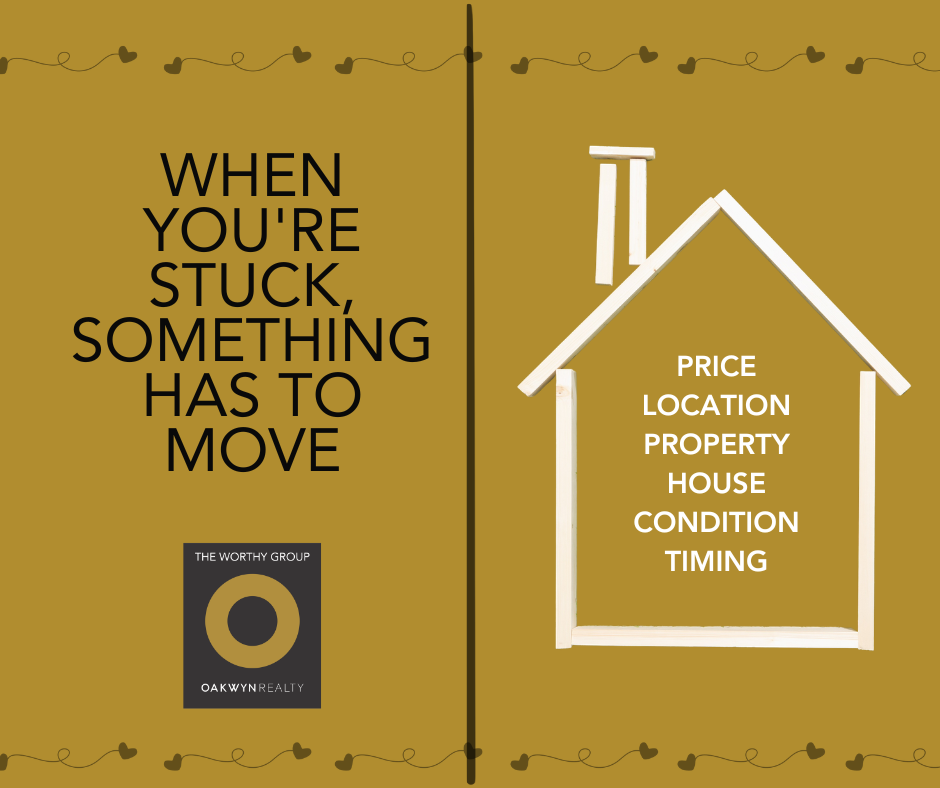
When You're Stuck, Something Has to Move

There are really only a handful of levers in a home search:

Price. Location. Property.
House. Condition. Timing.

If the market has repeatedly demonstrated that your preferred combination isn't available at your budget, one of those levers probably needs to move.

•  You can increase the budget.
•  You can change the location.
•  You can compromise on the house.
•  You can compromise on the land or improvements.
•  You can buy something that needs work and create what you want over time.
•  Or you can keep waiting, understanding that you may be waiting for something genuinely rare.

There isn't a wrong answer. But there should be a conscious answer.

Stop Looking for Perfect. Start Looking for Right.

The goal isn't to convince yourself to buy a house you don't like. It's also not my job as your Realtor to wear you down until you finally say yes to something.

My job is to help you understand the trade-offs the market is asking you to make and figure out which ones you can live with.

Sometimes that means waiting. Sometimes it means increasing the budget. And sometimes it means realizing that the three-bedroom house on a beautiful quarter acre with a fantastic shop actually gives you 95% of what you wanted.

The trick is knowing which 5% you're willing to give up, because the best home isn't necessarily the one that checks every box on the original list.

Want to Talk Through Your List?

It's the one that gets the most important things right.

— Catherine Worthy, MBA

Related Reading

August 2026 Market Update: Comox Valley & Campbell River

Buying a Home Together When You're Not Married

Sept. 10, 2026

August 2026 Market Update: Comox Valley & Campbell River Real Estate

Homes sold faster in both zones than they did last August. Fewer of them sold. Those two facts belong together, and reading them separately is how people get the wrong idea about where this market is headed.


Comox Valley

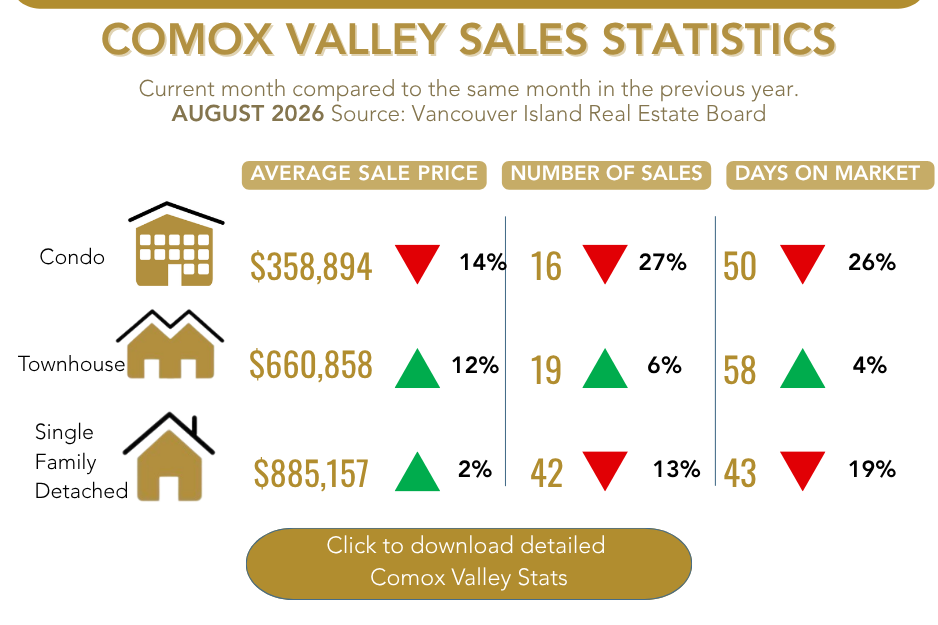
Detached homes sold in 43 days last month. The same month a year ago took 53. That's the clearest movement in either zone, and it happened while sales volume fell rather than rose: 42 detached homes sold against 48 last August, with new listings down too, 68 against 71.

Thin on both sides is a different market than weak. The buyers who are active are deciding quickly, and sellers are getting close to ask: detached homes closed at 97.7% of list price, townhouses at 98.4%.

Townhouses were the standout segment. Nineteen sold against only 16 new listings, with the average price up 12% to $660,858. That's genuine supply pressure in one specific segment. Condos look soft on the surface (16 sales against 22, average price down 14% to $358,894), but more condos sold in August than were newly listed, and active condo inventory has fallen from 84 units to 69 year over year. That's a segment working through its supply, not accumulating it.

One number worth reading carefully: the detached average of $885,157 is a single month on 42 sales. The rolling 12-month average sits at $919,604 and has climbed steadily since March. The monthly figure isn't a decline in values. It's a smaller sample.

Campbell River

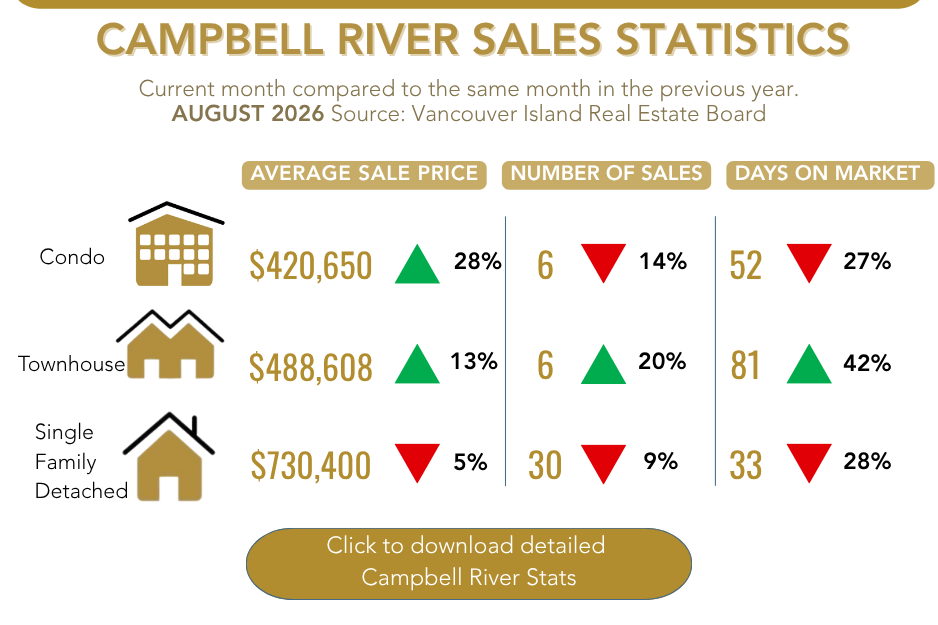
Detached homes sold in 33 days, down from 46, a 28% improvement and the fastest of any segment in either zone.

The supply picture here is the opposite of the Valley. New listings rose 18% year over year, 60 against 51, while sales fell 9%. Only half the homes listed in August sold. There's more room to negotiate in Campbell River than there has been in some time.

The detached average came in at $730,400, down 5%. On 30 sales, a monthly average moves on whatever happened to sell that month. The rolling 12-month figure is up 2.4% to $764,814. Read the trend, not the month. Townhouses are the one segment slowing down, at 81 days against 57 last year, but that's only six sales, a signal to watch, not a trend to act on.

What This Means for You

If you are selling, both zones moved homes faster than last August, and sale prices landed within two to three percent of asking. This market rewards realistic pricing rather than punishing it. What it does not reward is a high number and a wait.

If you are buying, Campbell River gives you more choice and more negotiating room than it has in a while. Comox Valley townhouses give you almost none. Where you look matters more this month than it did in the spring.

And whichever side you are on, get pre-approved. The five-year Government of Canada bond yield climbed roughly a quarter of a point over the past month, and lenders raised fixed rates through the end of August in response. Five-year fixed products now sit about 0.10% to 0.20% above where they started the year.

A pre-approval holds a rate for you, typically 90 to 120 days depending on the lender. If rates keep climbing, you keep the one you locked. If they fall, you get the lower rate instead. There is no version of this where holding a rate costs you something.

I am not a mortgage professional and I do not give rate advice. If you do not have a broker, I am happy to introduce you to one.

Market data sourced from Vancouver Island Real Estate Board (VIREB), August 2026. Rate information current as of September 9, 2026 and subject to change. Rate hold periods and terms vary by lender. For general interest only. No guarantees apply. Not intended to solicit properties already listed for sale.

Want the Numbers for Your Specific Street?

Zone-wide averages only tell you so much. If you're weighing a move in the next few months, I'll walk you through what's actually happening on your street or in your building, and what it means for your timing.

— Catherine Worthy

Related Reading

Comox Valley and Campbell River: Buyer's or Seller's Market?

Still Waiting for the Perfect Home? Here's What Might Actually Be Going On

Posted in Market Updates
Aug. 14, 2026

Home Improvement Rebates in the Comox Valley and Campbell River


Rebate programs in this region sit across provincial, utility, municipal and regional websites, and almost none of them point to each other. Most homeowners are leaving money unclaimed simply because they never found the right page.

The first question is not simply "What are you installing?" It is also "Where do you live, and how is your home heated now?" A Courtenay homeowner may qualify for a different local incentive than someone in a CVRD electoral area, while Campbell River has its own water-conservation rebates. Provincial energy programs generally apply throughout the region, but the rebate level and rules vary.

Heat Pumps and Heating-System Changes

For households at any income level, the Home Renovation Rebate Program currently offers up to $4,000 for replacing electric heating with a heat pump, plus up to $2,000 for windows and doors, $5,500 for insulation, and $1,000 for a heat-pump water heater.

Lower- and moderate-income households should check the income-tested Energy Savings Program before hiring a contractor. It uses three income tiers, can offer substantially larger rebates, and requires pre-registration before work begins. Once the installer's invoice is dated, that door closes.

Wood-Stove Replacement in the Comox Valley

The CVRD Wood Smoke Reduction Program offers up to $2,000 for eligible residents who remove a functioning wood-burning appliance, at least five years old and used as the home's main heat source, and replace it with an electric heat pump.

It covers Courtenay, Comox, Cumberland, K'omoks First Nation, CVRD Electoral Areas A, B and C, and Hornby and Denman Islands. Not income-tested, first come first served.

Campbell River and Septic Rebates

Campbell River currently offers $50 for an eligible high-efficiency toilet and $50 each for an eligible ENERGY STAR washer and dishwasher. Note that the City's $350 heat-pump top-up expired March 31, 2026, and is no longer active.

In the CVRD, Electoral Areas A, B and C also have access to a septic-system maintenance rebate of up to $700, one-time, for eligible inspection and component work.

Mortgage-Insurance Premium Refunds

This one surprises most homeowners: if your mortgage was insured through CMHC, Sagen, or Canada Guaranty, you may qualify for a 25 percent refund of the mortgage-insurance premium on qualifying energy-efficient work.

CMHC Eco Improvement applies to existing homes with at least $20,000 in eligible renovations, applied for within two years of closing. These refunds are separate from the municipal and utility rebates above, and in many cases can be claimed alongside them.

Verified July 31, 2026. Rebate rules and funding can change without notice. Confirm eligibility directly with the program administrator before ordering equipment or beginning work.

Want the Full Reference Sheet?

I keep a full, verified reference sheet with every program, income threshold, and official link for this region. If you're planning a renovation and want to know exactly what you qualify for before you sign a contract, reach out and I'll send it over.

— Catherine Worthy

Related Reading

Comox Valley and Campbell River: Buyer's or Seller's Market?

Foreclosure Does Not Automatically Mean a Great Deal

Aug. 14, 2026

Foreclosure Does Not Automatically Mean a Great Deal


What 25 years in mortgage lending and real estate have taught me about court-ordered sales.

We've all seen the ads: "Sign up to receive foreclosure listings." "Be the first to know about court-ordered sales." "Get weekly updates on distressed properties." They make it sound like foreclosures are a secret source of bargain-priced homes.

The reality is quite different. Most homeowners facing financial hardship sell their property before the bank begins foreclosure proceedings. Why? Because once the foreclosure process starts, legal fees, unpaid interest, penalties and other costs continue to accumulate. The homeowner typically ends up with less money, fewer choices, and less control over the process.

Banks also generally prefer owners to sell before foreclosure whenever possible. It reduces costs, allows the seller to choose the closing date and showing schedule, and often results in a better outcome for everyone involved.

Foreclosures Are Not Discount Sales

A court-ordered sale does not automatically mean you're getting a bargain. The court's role is to ensure the property has been properly marketed and that fair market value has been achieved as closely as possible.

When I list a foreclosure, I'm required to provide weekly reports detailing the marketing undertaken, the number of showings, buyer feedback, and every offer received. Once an offer is accepted, I prepare a detailed report for the court demonstrating that the property received appropriate market exposure and that due diligence was performed to obtain the best possible price.

Even then, the accepted offer is not necessarily the final sale. The court hearing is public, and the accepted purchase price is disclosed. Other buyers have the opportunity to attend court and submit a higher offer. If they do, the property may be sold to someone else.

Buyer Beware

If a foreclosure appears to be priced significantly below market value, there's usually a reason. Do your homework.

Unlike a traditional sale, the buyer assumes virtually all of the risk. Court-ordered properties are sold as is, where is, with no representations or warranties. If problems arise after closing, your legal remedies are pretty much non-existent. Foreclosures are the very definition of buyer beware.

So Where Are the Best Deals?

If your goal is simply to buy well, there are often better opportunities than waiting for a foreclosure. Study the market. Watch active, pending and sold listings so you understand the price points of where homes are actually selling. Look for properties that have been thoughtfully priced below competing listings or have experienced meaningful price reductions.

The best deals often come from making your offer more attractive rather than simply offering less money:

Have Your Financing Approved

A seller weighing two similar offers will take the one that is least likely to fall apart. Arrange your insurance in advance for the same reason.

Remove Subjects Quickly Where Appropriate

Time is a cost to a seller. Shortening the period of uncertainty has real value, and it costs you nothing if your due diligence is already organized.

Be Flexible on Closing and Repairs

Work with the seller's preferred closing date. And don't ask them to fix every minor issue if you're prepared to handle them yourself.

Here's the secret most buyers miss: price is only one part of a negotiation.

Every seller has pain points. Your job is to identify them and eliminate as many as possible. Do that, and you'll often achieve a better overall deal than someone who simply submits the lowest offer.

After more than 25 years in mortgage lending and real estate, I've seen this strategy succeed time and time again.

— Catherine Worthy

If you're weighing a court-ordered sale, or trying to build a stronger offer on a conventional listing, a short conversation will save you a great deal of guesswork.

This article is general information, not legal advice. Court-ordered sale procedures vary by case. Consult a lawyer before proceeding with a foreclosure purchase.

Related Reading

Comox Valley and Campbell River: Buyer's or Seller's Market?

Home Improvement Rebates in the Comox Valley and Campbell River

Aug. 14, 2026

Comox Valley and Campbell River: Buyer's or Seller's Market?

Summer in the Comox Valley and Campbell River always brings me the same question, in one form or another: is this a good time to buy, or a good time to sell?

The honest answer is that it depends far less on the calendar than on your price range.

The Answer Is Both

One of the biggest misconceptions in real estate is that the entire market moves in the same direction. In reality, the market changes depending on the price range.

In both the Comox Valley and Campbell River, homes in the more affordable price ranges often attract multiple buyers because more people can afford them. Well priced homes under the local median price frequently sell quickly and can create conditions that favour the seller.

As prices climb into the upper end of the market, the number of qualified buyers becomes much smaller. Luxury and high-end homes generally face more competition from other listings, take longer to sell, and buyers often have more negotiating power. That shifts the advantage toward the buyer.

The result is that two homes on the same street can experience completely different market conditions simply because they fall into different price brackets.

July 2026 by the Numbers

July's figures show this clearly. In the Comox Valley, single family detached homes averaged $963,956, up 8 percent year over year, and sold in 36 days, 20 percent faster than the same month last year. Townhouses moved even faster, down 40 percent on days to sell.

Comox Valley sales statistics, July 2026, source Vancouver Island Real Estate Board

Campbell River sales statistics, July 2026, source Vancouver Island Real Estate Board

Campbell River tells a different story in the same month. Single family detached rose 13 percent to average $829,163, but took 64 days to sell, a third longer than last July. Townhouses sat longest of all at 101 days. Same region, same month, two very different sets of conditions depending on what and where you are selling.

Ask a Better Question

Instead of asking, "Is it a buyer's market or a seller's market?" the better question is: "What is happening in my price range?"

This is why headlines can be misleading. That answer has a much bigger impact on pricing strategy, negotiating power, and how long your home is likely to take to sell.

What This Means for You

If you are selling in a competitive bracket, pricing well matters more than pricing high. If you are selling at the upper end, patience and presentation carry more weight than they did two years ago.

And if you are buying, knowing which side of that line your search sits on tells you how much room you actually have to negotiate.

Source: Vancouver Island Real Estate Board (VIREB) Q2 2026 Market Overview and monthly market statistics. VIREB notes that buyers remain selective, well priced homes continue to attract strong interest, and properties priced above market expectations typically require more time to sell, illustrating that market conditions vary by price segment rather than affecting all homes equally.

Also in This Month's Worthy Report

Home Improvement Rebates in the Comox Valley and Campbell River
Heat pump, insulation, wood stove and septic rebates, plus the mortgage insurance refund most homeowners never hear about.

Foreclosure Doesn't Automatically Mean a Great Deal
What court-ordered sales actually involve, and where the better opportunities usually hide.

In the Community: Summer Pulse on the Plaza

Summer Pulse on the Plaza Pride Party, Downtown Courtenay, August 28 2026

We're a proud sponsor of Summer Pulse on the Plaza's final event of the season, a free, all-ages celebration of Pride in Downtown Courtenay, presented in partnership with Queer Centre Comox Valley.

Come celebrate, create, and dance with your community as the Music & Arts Mini Fest closes out the summer. Free admission, all ages, all welcome.

Date & Time: August 28, 2026, 5:00 PM to 9:00 PM
Location: Downtown Courtenay

Stage line-up: Queer As Funk · Devours · Mean Bikini

Art making activities: Andy MacDougall screen printing · Make Art with CVAG · CV/Arts Art Wagon shiny shoes · Cleo Butcher's Tickle Trunk · Phillipe Duprey's Human Library

Food & drinks: The Ice Cream Peddler · Queer Centre Comox Valley bar, featuring alcoholic and non-alcoholic drinks

Summer Pulse on the Plaza 2026 is brought to you in collaboration with Comox Valley Art Gallery, Comox Valley Arts, Elevate the Arts, and the Downtown Courtenay Business Improvement Association.

Curious What Your Home Is Worth?

Whether you're weighing a sale, planning a renovation, or simply trying to understand where your price range sits in this market, a short conversation will tell you more than any headline.

April 13, 2026

The Worthy Downsize Sellers Program

The Worthy Downsize Sellers Program

At The Worthy Group, we believe that every move should feel like a fresh start, not a mountain to climb. That's why we created a program built specifically for people who are ready to downsize but aren't sure where to begin, or simply don't want to do it alone.

Whether you're moving into a smaller home, a condo, or a retirement residence, we handle the details so you can focus on what's next.

How It Works

Every situation is unique, which is why we start with a conversation, not a checklist.

We Listen First

We meet with you at your home or our office to understand your timeline, your goals, your family situation, and what kind of support would make this transition easier. No pressure, no rush.

We Build a Plan Around You

Once we understand your needs, we customize a selling package and pricing structure that fits your specific situation. Nothing cookie-cutter.

We Get Your Home Ready

From minor repairs to full cleanouts, we coordinate trusted local tradespeople and service providers so you don't have to chase anyone down.

We Clear the Home

Once you have taken everything you want, we arrange help to sort, organize, and remove everything you're leaving behind, donating to local charities where possible and responsibly disposing of the rest.

We Prepare and Present

We professionally clean and prepare your home so it shows beautifully and sells for what it's worth.

We Sell (and Help You Buy, If Needed)

We list and sell your home, and if you're purchasing something new in the area, we're with you every step of that journey too.

Real Stories From People We've Helped

"She just needed someone to take care of it."

One of our clients had received placement at a retirement home. Her family helped move her personal belongings to her new room, but the house — three bedrooms, two bathrooms, and a full yard of memories — still needed to be dealt with. We came in, sorted through everything, worked to sell higher-value items, donated the rest to local charities, arranged disposal of what remained, and cleaned the home from top to bottom before listing it. Throughout the process, we kept the family informed so they could focus on helping Mom settle into her new home, without worrying about the house.

"The family was grieving. The last thing they needed was logistics."

After a father passed away, his children came and took the items that meant the most to them. We handled everything else — sorting, arranging removal of furniture, clearing the home, and doing a full clean before listing. It wasn't a simple job, but it didn't need to be their burden to carry.

"She was on her own, and we made sure she didn't feel that way."

One client was the executor of her mother's estate but lived out of town. We helped organize packers, cleaners, a painter, and new carpeting while she worked through the probate process, so that once probate was granted, we could hit the ground running.

What Does It Cost?

It depends on what needs to be done. Because every home and situation is different, we scope the support before quoting anything — that way you get a clear picture of what's involved with no surprises. What we can tell you is that every client has said it was worth it, and that they wished they had known sooner that this kind of support was available.

Our philosophy is simple: the buying and selling process should work for you, not the other way around.

This program isn't for everyone, and if it's for you, you already know. If you have all the help and support you need, that's wonderful. We would still love to sit down and talk about your future and how we can make selling your home as smooth as possible.

Ready to take the first step? We'd love to sit down with you, or with someone you love, and talk through what this could look like. No obligation, just a conversation.

Posted in Worthy News
April 13, 2026

Comox Valley & Campbell River Market Update – April 2026


CATHERINE'S STATISTICAL ANALYSIS – April 2026

March 2026 shows encouraging signs of growth, much like the early stages of spring.

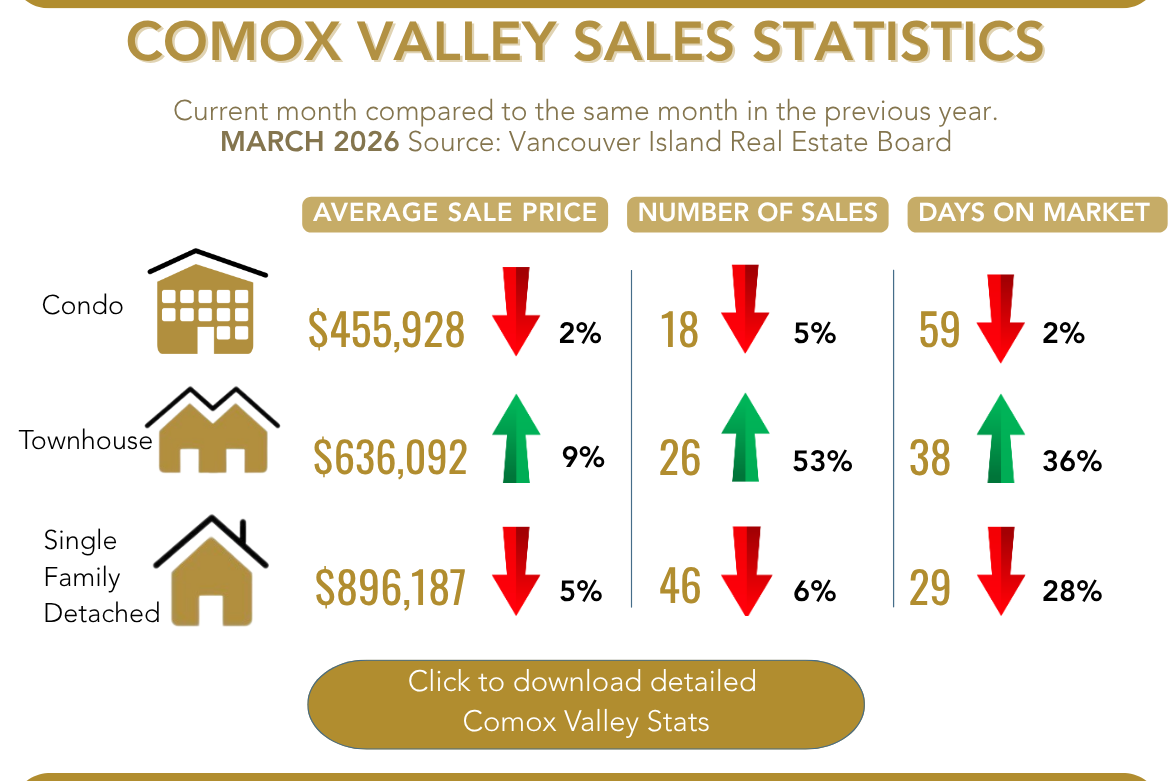
In the Comox Valley, the single-family residential market remains steady. Listings and sales are closely aligned with last year, while average sale prices have softened by approximately 5 percent. Homes are moving more quickly, with days on market decreasing from 40 to 29 days.

The condominium market remains consistent in terms of both listings and sales volume. Average sale prices have declined by approximately $10,000, and days on market are holding at around 60 days.

Townhouses present a different story. There are fewer listings and increased sales activity, with prices rising by approximately 10 percent. However, properties are taking slightly longer to sell, with days on market increasing to 38 days compared to 28 days last year.

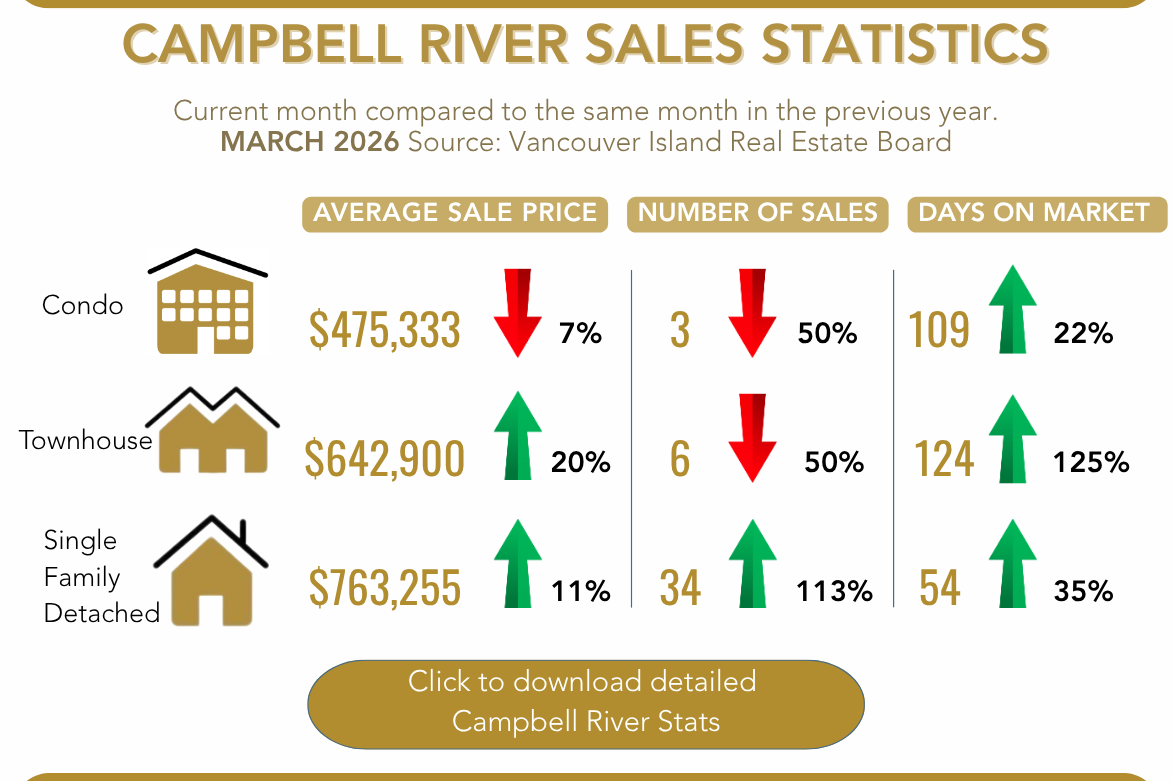
In Campbell River, the single-family market has strengthened significantly. Listings are up by 50 percent and sales have more than doubled, increasing by 110 percent. Average sale prices have risen by 10 percent, although homes are taking longer to sell, with days on market increasing from 40 to 54 days.

The condominium market in Campbell River remains very quiet, with only three sales recorded in March. The average price has declined to $475,000 from $509,000, and days on market have increased to 109 days compared to 89 days last year.

The townhouse market shows stable listing numbers, but sales have decreased by 50 percent. Despite this, average sale prices are approximately $90,000 higher than last year. The condominium and townhouse segments both require patience right now. Townhouse days on market have risen significantly, from 54 to 124 days.

Within Campbell River, Central Campbell River and Willow Point led sales activity. In the Comox Valley, the majority of transactions occurred in Comox, Courtenay City, and Courtenay East.

What this means for you

We are moving into a more balanced and nuanced market. Opportunities are present, but success depends on strategy, timing, and realistic expectations. Sellers need to be thoughtful with pricing and prepared for varying timelines depending on property type. Buyers have more choice and room to make informed decisions, but well-positioned homes are still attracting strong interest.

If you are considering a move this year, the most important step is having a clear, personalized plan. The right guidance can make the difference between simply participating in the market and truly benefiting from it.

I am always here to help.
Book a call with Catherine


If you’re thinking about buying, selling, or both in early 2026, the next 6–8 weeks are all about positioning. The decisions you make now directly affect your leverage in the spring market. If you want a personalized breakdown for your neighborhood or property type, that’s exactly what we’re here for.

Posted in Market Updates
March 23, 2026

Why Lenders Trust Me as Their Go-To Foreclosure Specialist Throughout Vancouver Island

When a mortgage goes into default, it's never just a transaction, it's a complex, time-sensitive process that requires experience, strategy, and a steady hand.

That's where I come in.

With over 20 years of experience in mortgage lending and bank financing, I bring a perspective to foreclosure sales that most Realtors simply don't have. I understand how lenders think, how files are managed behind the scenes, and what needs to happen to protect both timelines and bottom lines.

If you're a lender, asset manager, or legal professional handling foreclosure properties on Vancouver Island or the Gulf Islands, here's exactly what you need to know.

Foreclosure Sales Are Not Typical Real Estate Transactions

Selling a foreclosure property isn't the same as listing a family home.

There are court timelines, strict documentation requirements, and a need for complete transparency at every step. Pricing has to be strategic. Marketing has to be targeted. And communication has to be consistent and professional.

Most importantly, there is no room for guesswork.

I approach every foreclosure file with a clear plan:

  • Accurate market valuation backed by real data
  • Strategic pricing to attract strong, clean offers
  • Exposure designed to reach qualified buyers quickly
  • Ongoing reporting to keep lenders and legal teams informed

Because in foreclosure, time is not your friend, and delays cost money.

My Background Gives Lenders a Serious Advantage

Before real estate, I spent over two decades in mortgage and bank financing.

That means I don't just understand the sales side. I understand:

  • Risk management from a lender's perspective
  • How loan files are structured
  • The pressure institutions face to recover losses efficiently
  • The importance of compliance, documentation, and timelines

This isn't something you can fake or learn overnight.

It allows me to anticipate problems before they happen, navigate challenges smoothly, and keep transactions moving forward without unnecessary friction.

Protecting Value While Moving Quickly

Foreclosure sales often come with a balancing act:

  • Sell too fast, and you risk leaving money on the table
  • Price too high, and the property sits, costing more in the long run

My job is to walk that line with precision.

I focus on:

  • Positioning the property to attract serious buyers
  • Creating urgency without sacrificing value
  • Minimizing days on market while maximizing return

Every decision is made with one goal in mind: protecting the lender's financial outcome.

Clear Communication. No Surprises.

If you've ever dealt with a foreclosure file, you know how frustrating poor communication can be.

I make this part simple.

You can expect:

  • Regular updates on showings, feedback, and market response
  • Clear reporting on offers and negotiations
  • Immediate communication when something needs attention

No chasing. No guessing. No surprises.

Local Expertise Matters

The Vancouver Island markets are unique. Buyer behavior, pricing trends, and property demand can shift quickly depending on location, property type, and timing.

I combine my financing background with deep local market knowledge to ensure each property is positioned correctly from day one.

A Reliable Partner for Foreclosure Sales

Lenders need more than just a Realtor. They need someone who understands the full scope of the process and can execute without hand-holding.

That's exactly what I provide.

If you're managing foreclosure properties and need a trusted, experienced partner who knows both real estate and lending inside and out, let's connect. I have lived throughout Vancouver Island for over 45 years. I personally manage foreclosures from Mill Bay to Port Hardy, and will refer to Victoria specialists for Sooke to Sidney properties.

Let's get your asset sold efficiently, professionally, and with your bottom line protected.
Contact me by booking your session now!